
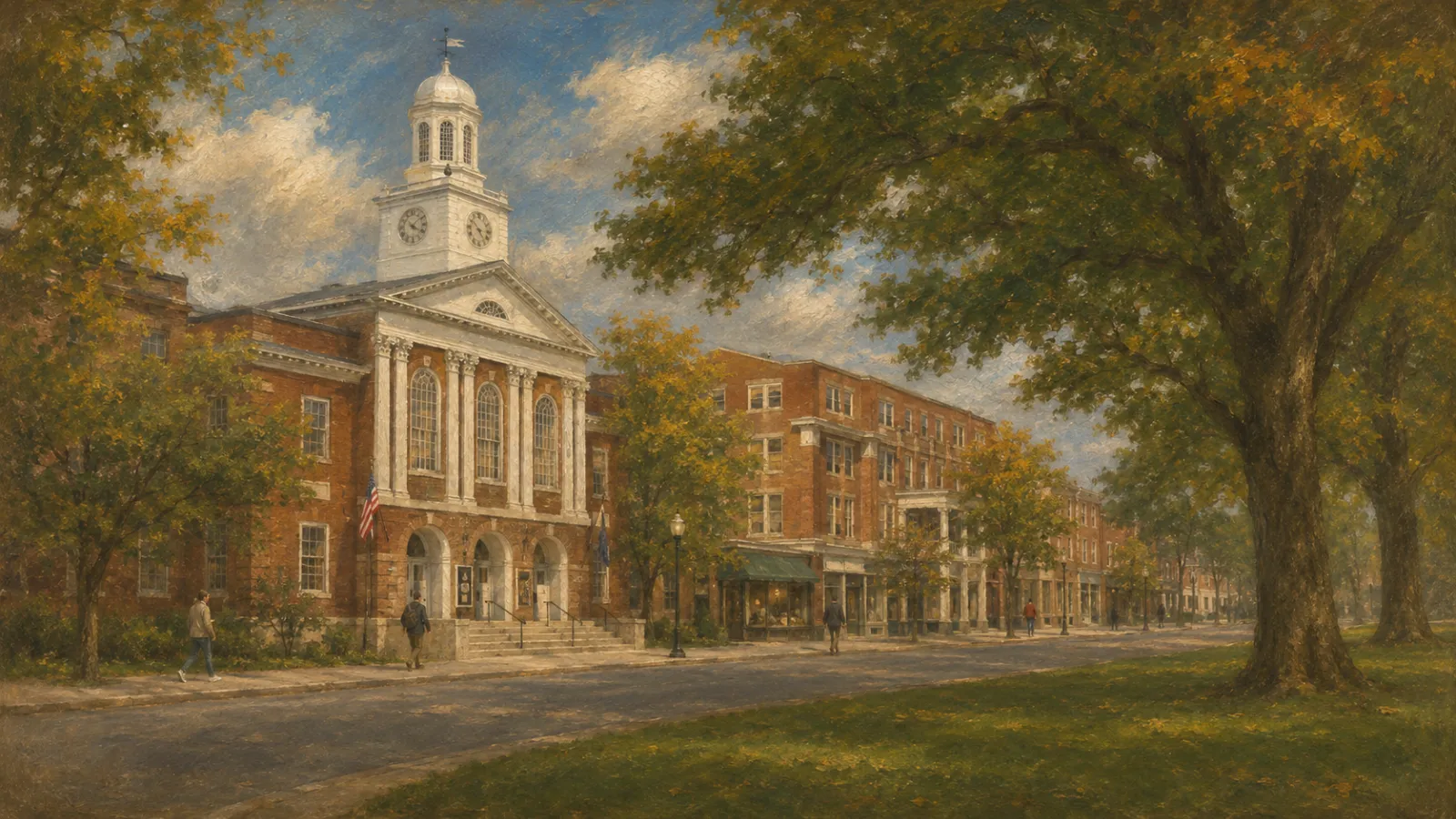
Imagine the building that houses my town’s coffee shop is for sale. The landlord wants $1.3 million, and the coffee shop doesn’t have it. Someone else could buy the building, raise the rent, and turn a place people love into a place people remember.
But suppose two thousand of us each put in $250.
That would raise half a million dollars. With a mortgage, perhaps it would be enough to buy the building and keep the coffee shop there. The business could remain independently owned and operated. We would own the property and become its landlord.
I want to work through that possibility. This is a hypothetical, not an investment offer or legal advice. The numbers are starting assumptions, and there are plenty of reasons a purchase like this might fail. But it seems worth asking what it would take—and what we might get from doing it together.
Having something at stake
I think community has something to do with obligation. People become a community when they need things from each other and accept some responsibility for providing them.
A coffee shop gives that idea a place to happen. People work there. People meet there. Someone opens in the morning, someone fixes the plumbing, and someone pays the bills. Customers can enjoy the place without knowing much about those arrangements. Ownership would give some of us a reason to learn.
Putting in $250 would mean accepting the possibility of losing it. Electing a board would mean trusting neighbors with decisions about our money. Serving on that board would mean doing work that people might complain about.
There is something appealing to me about that. We could take a familiar part of town and accept responsibility for its continued existence.
The arrangement would use an ordinary commercial transaction: buy a building, collect rent, maintain it, repay a loan. Its purpose would be to keep a local place available on terms the community could help determine.
Whether that purpose survives contact with the mortgage is another question.
What half a million dollars buys
Suppose the building costs $1.3 million and a lender is willing to finance 75 percent of the purchase price.
The mortgage would be $975,000. We would need $325,000 toward the purchase, leaving $175,000 from the community’s $500,000 contribution.
That remaining money would have several jobs. Raising the money costs money. So do legal work, accounting, inspections, closing, insurance, repairs, and running the organization after the purchase.
For a first pass, suppose we set aside $55,000 for fundraising and professional expenses. That leaves $120,000. Reserve another $30,000 for three years of administration, and we have $90,000 for property closing costs, repairs, and cash reserves.
Those expense figures are placeholders, not quotes. A building inspection or a conversation with a lender could change the whole calculation.
We also haven’t answered the question that matters every month after closing: can the coffee shop afford the rent this building requires?
The rent would need to support mortgage payments, property taxes, insurance, maintenance, administration, and reserves for vacancies and major repairs. The owners would need to understand the lease and who pays which expenses. A roof will eventually need replacing even if everyone likes the landlord.
Community ownership gives us some control over the rent. It doesn’t eliminate the costs beneath it.
If the building requires more rent than the coffee shop can afford, we would have to change something. Pay less for the property. Borrow less. Find grants or other capital with more forgiving terms. Consider additional rental income, if the building allows it. Or decide the purchase doesn’t work.
I would want to discover that before asking two thousand neighbors for their money.
Who owns what?
In the simplest version of this hypothetical, we form a company to own the building. The coffee shop remains a separate business and signs a lease with that company.
The owners elect a board. The board oversees the property and appoints or hires people to manage it. Someone keeps the books, handles maintenance, communicates with the tenant, and makes sure the organization meets its obligations.
If everyone buys the same share for $250, equal ownership is easy to describe. But what happens when one person wants to contribute $25,000? Do they get a hundred times the votes?
That question forces us to say what we mean by community ownership.
We might want financial contributions to determine voting power. We might want each member to have one vote. We might want an arrangement that protects the building’s community purpose even when owners change. Each choice would need an appropriate legal structure and a clear explanation of what contributors receive.
There is also a problem with making investment the only way to belong. Some people can spare $250. Some cannot. People might contribute time, maintenance skills, organizing, bookkeeping, or oversight. Those contributions do not automatically pay the purchase price, but they could be essential to keeping the organization alive.
I would want the structure to make room for that work and give people a meaningful role. Otherwise, we could end up calling something community ownership when we mean ownership by the neighbors with available cash.
We would also need to be honest about the investment itself. Are owners expecting dividends? Could they sell their shares? What happens if they need their money back? How much could they lose?
“Helping keep the coffee shop open” might be a good reason to participate. It isn’t a complete description of what someone is buying.
Raising the money
Asking two thousand people to buy shares brings securities law into the project.
One possible route is Regulation Crowdfunding, usually called Reg CF. It allows eligible companies to raise investment from the public, including people who are not accredited investors, through a registered broker-dealer or funding portal. It requires disclosures and financial information, and generally brings annual reporting duties after a successful offering. The SEC’s guide for issuers explains the requirements.
Whether it is the right route for this particular property company would need legal review. We would also need advice on the entity, its governing documents, tax treatment, state requirements, and what we can say publicly while organizing the raise.
That work belongs in the budget from the beginning.
I suspect it would be tempting to start with an enthusiastic announcement: we’re buying the building, shares are $250, who’s in? Before doing that, I would want someone qualified to help us distinguish a conversation about the idea from an offer of an investment.
The enthusiasm could be useful. We would need to give it somewhere lawful and practical to go.
Where it gets difficult
Two thousand people is a lot of people to reach.
Some will like the idea and never get around to participating. Some will ask questions we haven’t answered. Others will reasonably prefer to keep buying coffee without becoming part of the landlord.
Suppose we raise $300,000. We would need to know whether a smaller purchase plan works, whether other financing is available, or whether the effort stops. “We got pretty close” won’t pay the seller.
Then there is the building. An inspection could uncover a problem expensive enough to consume the reserve. The lender could require terms we cannot accept. The coffee shop’s finances could be weaker than we hoped.
Even a successful purchase leaves plenty to argue about.
The board might decide the rent needs to rise. Owners might disagree about paying dividends or retaining cash. Someone might want to sell the building after its value increases. The coffee shop could close despite our efforts, leaving us to choose a new tenant.
We would need rules for those decisions before they become personal. Who can authorize a sale? What is the organization committed to preserving? How do owners replace a board they no longer trust? What happens when the people doing the work want to stop?
The ongoing work concerns me as much as the fundraising. A successful campaign has an obvious finish. Property management continues. Someone has to respond when the tenant calls, find a contractor, review the accounts, and explain an unpopular expense.
I would want those jobs named, budgeted, and assigned. Depending indefinitely on whoever feels most responsible seems like a good way to exhaust a few people.
Working through your own version
An AI agent could help someone get far enough into this idea to ask better questions.
I would begin with a plain description:
A building in my town is for sale. We want to explore community ownership so the existing coffee shop can stay. Help me list what we need to learn before deciding whether to pursue it. Separate information about the property, the business, financing, governance, and legal requirements. Mark what you cannot verify.
Then I would work on the finances:
Build a simple model using this purchase price, down payment, and loan terms. Include taxes, insurance, maintenance, administration, vacancy, and repair reserves. Show the rent required under several scenarios. Label every assumption and leave unknown figures blank.
The blanks would be useful. They would become questions for the seller, the tenant, an inspector, an insurer, or a lender.
I would also use it to test the ownership arrangement:
Compare ways contributors might participate in decisions. What changes if voting follows investment size? What changes if each member has one vote? How might people who contribute work participate? Identify the questions we need a lawyer to resolve.
An agent can help organize documents, compare proposals, check arithmetic, and keep track of unanswered questions. I would still want the underlying evidence: the lease, actual expense records, inspection reports, financing terms, and current official sources for legal claims.
Before anyone puts money at risk, qualified people would need to review the parts they are responsible for. An agent could make those conversations more focused by helping us arrive with a coherent proposal and a list of things we still don’t understand.
After the purchase
I don’t know whether this particular hypothetical would work. We haven’t established that the building can support the debt, that two thousand people would participate, or that the organization could keep doing its job after the excitement of buying something wears off.
I am interested in what trying would require us to learn.
We would have to talk about how much money people can afford to lose, whose work counts, who gets to decide, and what we are willing to pay to keep a place available. We would have to decide whether we trust each other enough to proceed.
And if we did buy the building, there would eventually be an ordinary meeting about an ordinary problem: a repair, a lease renewal, an expense nobody wanted.
I think that meeting is part of what I’m looking for. A reason to show up, with people who need something from me, to take care of a place we have agreed is worth keeping.